Five AI models, five jobs: the 2026 stack
Frontier benchmarks have converged. The price spread is 178×. The best AI model isn't a thing — the best for each job is. Here's the 2026 stack.
 Mahendhar Seelam
6 min read
Claude Opus 4.7, Gemini 3.1 Pro, and GPT-5.5 score within 2 points of each other on broad reasoning. One costs $25 per million output tokens. One costs $0.28. The "best AI model" framing is over.
That's the situation in April 2026. The frontier has compressed: every major lab is in the same band on reasoning, coding, and multimodal benchmarks. Picking between Claude / Gemini / GPT on raw quality alone is closer to a coin flip than a debate. What's not compressed is everything else — price (a 178× spread), latency, training data freshness, license, and which job the model actually wins on.
Five jobs every engineering team hits in 2026. Five models that win them. None of them is "the best" — they win at different things. The full benchmark picture is on the Artificial Analysis leaderboard if you want to verify.
TL;DR — Coding agents → Claude Opus 4.7. Long-context reasoning → Gemini 3.1 Pro. General-purpose production → GPT-5.5. Cheap volume → DeepSeek V4. Self-hosted / data-sovereign → Llama 4. Stop optimising for "the best", start matching the model to the workload.
1. Coding agents → Claude Opus 4.7#
The benchmark that matters here is SWE-bench Verified — real GitHub issues, real fixes, scored on whether the patch actually passes the test suite. Opus 4.7 ships at 82%. That's measurably above Gemini 3.1 Pro (78.8%) and GPT-5.5 (similar band) on this specific task.
What this translates to in practice: agents that edit multiple files, run tests, and recover from regressions actually finish the work instead of stalling. The 4-point delta isn't academic — at SWE-bench-grade difficulty, those four points are the difference between a job done and a Friday afternoon of intervention.
Use it for: Claude Code, Cursor, multi-turn coding agents, anywhere a wrong answer is more expensive than a slow answer.
Skip it for: classification, summarisation, extraction. Opus is wasted on those.
Pricing: $5 / $25 per MTok, with prompt caching bringing input down 10× on reused prefixes. The Claude in 2026 field guide covers the cost math.
2. Hard reasoning + multimodal → Gemini 3.1 Pro#
Gemini 3.1 Pro leads three independent benchmarks in April 2026: SWE-bench at 78.8%, GPQA Diamond at 94.3% (frontier-level on graduate-science questions), and ARC-AGI-2 at 77.1% (the abstract-reasoning benchmark Google DeepMind uses to argue about novelty).
The 2M-token context window is also unique in this band. For genuine long-context work — analyse a whole codebase, summarise a year of meeting transcripts, audit a 500-page contract — Gemini is the answer. Most "long context" use cases collapse back to RAG once you hit ~200K, but the workloads where 2M actually pays off (real archival reasoning) need Gemini.
Multimodal handling is a strict win too — vision and audio land in the same call without orchestration.
Use it for: long-document reasoning, multimodal pipelines, scientific or analytical workloads, anywhere you genuinely need >200K of context.
Skip it for: short-context chat, agentic coding (Opus wins there), high-volume cheap work (overkill).
Pricing: Gemini 2.5 Pro at $1.25 / $10 per MTok; 3.1 Pro Preview pricing tracks similarly.
3. General-purpose production → GPT-5.5#
GPT-5.5 isn't the highest scorer on any single benchmark, but it's at parity on most and has the deepest ecosystem maturity. Tool use is rock-solid. Function calling with strict JSON schemas works first time. The Agents SDK has been in production at thousands of companies for two years now. Documentation is the most complete in the space.
This is the "boring works" choice. If you're building a customer-facing chat product, an agent that calls 30 tools, or a pipeline where the model is one component in a larger system, the operational profile of GPT-5.5 is unmatched.
Pricing: $5 / $30 per MTok, with the 5.5-pro tier at $30 / $180 for the truly hardest jobs.
Use it for: general production agents, established tool-use workflows, anything where operational maturity matters more than the last 4 points on a benchmark.
Skip it for: anywhere price matters (DeepSeek wins), or self-hosting (Llama wins).
4. High-volume cheap work → DeepSeek V4#
DeepSeek V4 sits 3-6 months behind frontier on raw quality but charges $0.14 per million input tokens, $0.28 per million output. That's 89× cheaper input than Opus 4.7 and 89× cheaper output.
For workloads where the quality difference doesn't matter — first-pass classification, deduplication, summarisation of structured data, batch labelling, anything you'd otherwise build a fine-tuned BERT for — V4 is the answer. The math just works.
The trap: "Don't I want frontier-quality everywhere?" No. If you're processing a million support tickets nightly, the price difference between V4 and Opus is real money — five figures a month. The quality delta isn't visible at the task you're actually doing.
Pricing: $0.14 / $0.28 per MTok. The smaller V4 Flash is cheaper still.
Use it for: nightly batch jobs, classification at scale, content moderation, RAG retrieval scoring, anywhere you'd happily trade 5% quality for 99% cost cut.
Skip it for: agentic work, anything user-facing where latency or quality is visible.
5. Self-hosted / data-sovereign → Llama 4#
The other four models leave your data center. For some workloads — anything regulated, anything where the prompts contain secrets, anything in a jurisdiction with data-residency laws — that's a non-starter.
Llama 4 Maverick is open-weight, beats GPT-4o on most benchmarks, supports multimodal, and you run it on your own GPUs. The price isn't dollars per token; it's whatever your H100s cost amortised over the year. For high-volume internal use, that breaks even fast.
Mistral Large 3 is the close second here — also open-weight, 256K context, EU-headquartered (matters for some compliance regimes).
Use it for: regulated industries (healthcare, finance), enterprise on-prem, RAG where the documents themselves are sensitive, hardware you've already paid for.
Skip it for: small-volume work where you don't break even on the GPU spend, anywhere you need the absolute cutting edge (open-weight is reliably 6 months behind closed frontier).
The skip list#
Three classes of model that show up on "best AI" lists and shouldn't be in your stack:
- Older flagships still being sold at premium prices. GPT-4o, Claude 3 Opus, Gemini 1.5 Pro — all charging more than the current generation for less performance. Migrate.
- Niche "specialist" models. Models tuned for "creative writing" or "math" or "code-only" — the frontier models do these jobs at the same level now. The specialist had a moment; the moment ended.
- Multi-agent novelty (so far). Grok 4.20's parallel-agent architecture is interesting and benchmarks well, but the operational maturity isn't there yet. Wait one more cycle unless you specifically need real-time X data.
The decision tree#
Three questions, in order:
- Is the data sensitive enough that "leaves your data center" is unacceptable? → Llama 4. Stop here.
- Is volume the dominant cost factor? → DeepSeek V4. Worth the 5% quality drop.
- Otherwise: Claude Opus 4.7 for coding agents, Gemini 3.1 Pro for reasoning + long context, GPT-5.5 for everything else.
That's it. Skip the meta-debate about "which AI is smartest". The benchmarks have converged; the question is which is right for this job.
The takeaway#
Five models, five jobs. Match the model to the workload, not the headline benchmark. The frontier compressed in 2026 — the price spread didn't.
Comments (0)
Sign in to comment.
No comments yet. Be the first.
Related reading

Product Engineering
Claude in 2026: the engineer's field guide
Three models, three prices, twenty-fold savings if you cache and batch. The reference I send new hires when they ask 'what should I know about Claude?'
7 min read
DevOps
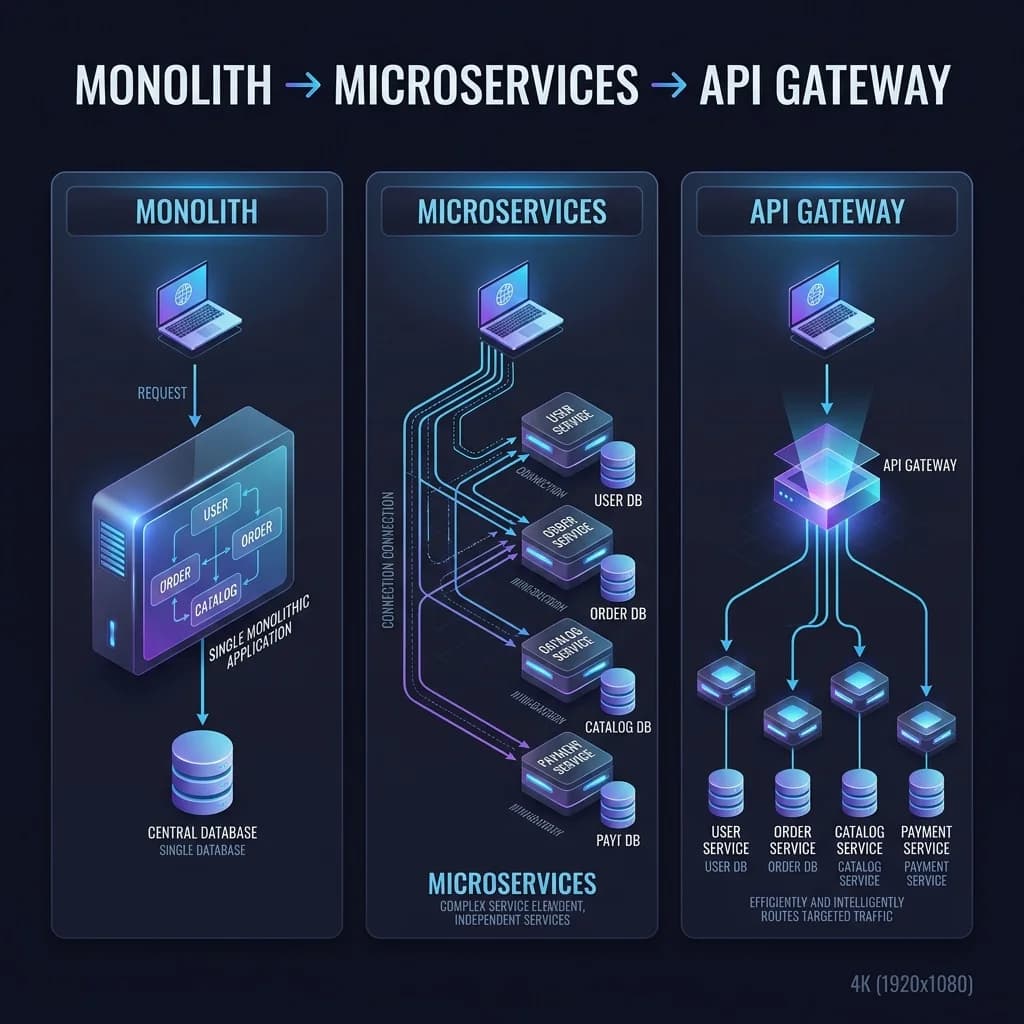
Monolith → microservices → API gateway: the three-diagram explainer
Three diagrams, three architectures, one front door. The clearest way to understand why teams move from a single server to microservices behind an API gateway.
6 min read